The chip industry, on one page.
No single company makes a chip. It's built by a chain of specialists across six worlds. Here's the whole map — what each world does, and where to start learning if you want in. Free, no account, just read.
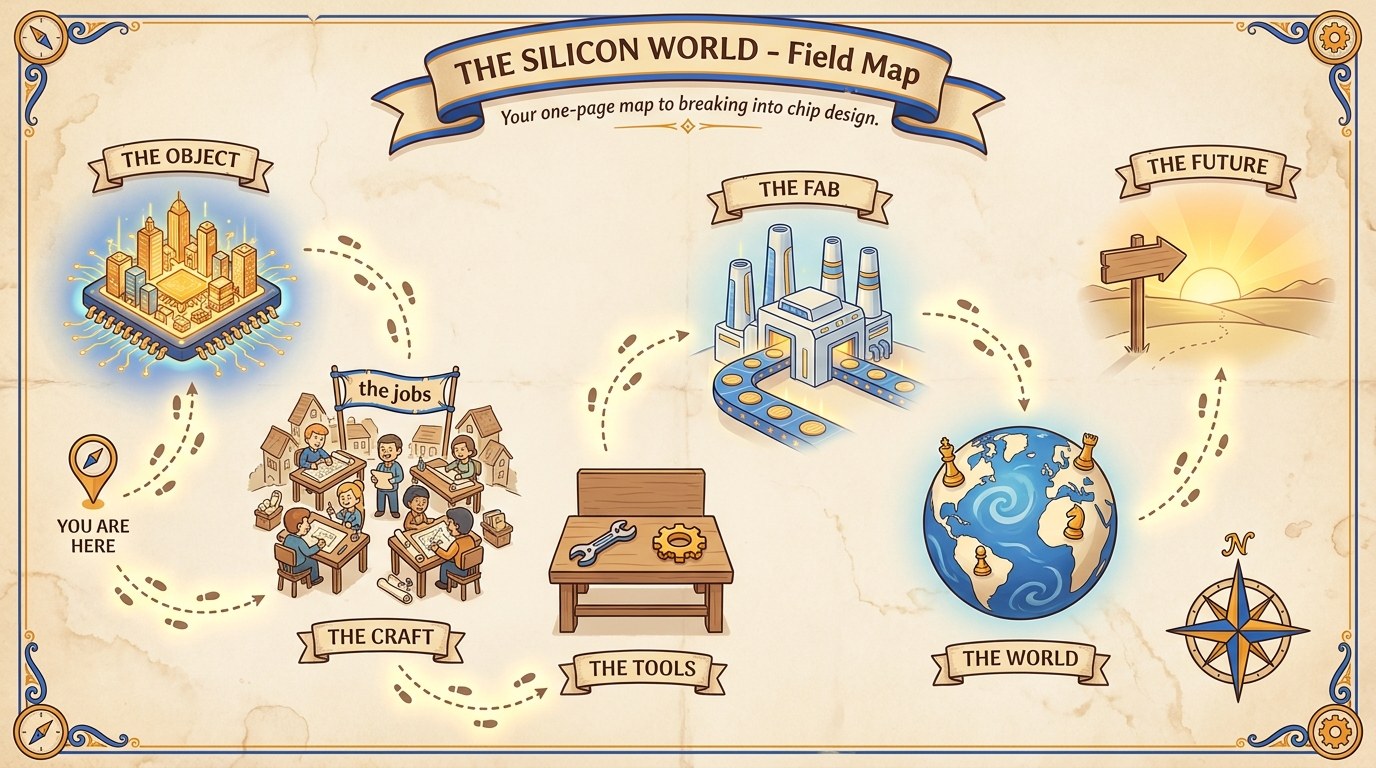
1 · The Object — what a chip actually is
Start here: a chip is billions of microscopic switches (transistors) wired into a tiny city on a sliver of silicon. Understand the ladder from a single transistor up to a full system-on-chip, and the split between logic, memory and analog.
2 · The Craft — the people who design one
The real jobs: the architect who plans it, the RTL designer who writes its behavior, the verification engineers who quietly eat two-thirds of the project, and the physical-design and signoff engineers racing timing and power. This is where most careers live.
3 · The Tools — the software that builds chips
You can't design a chip by hand. A stack of EDA tools turns intent into silicon — and a growing open-source toolchain (simulation, synthesis, timing) lets you practice the real flow for free.
4 · The Fab — how they're physically made
The most complex factories humans have ever built: lithography, EUV, yield, packaging. Understand why a modern fab costs tens of billions, and why the whole planet leans on a handful of buildings.
5 · The World — the geopolitics
Choke points, export controls, why Taiwan, the memory race. Read the news like an engineer: not “good guys vs bad guys”, but who holds which piece nobody else can make.
6 · The Future — where it's heading
RISC-V and open silicon, chiplets, AI in the design loop — and the honest question of whether today's hardware prices are a permanent squeeze or a cycle. This is where a curious person can still get in early.
Where to start
If you're new, learn them in this order — Object → Craft → Tools → Fab → World → Future. Get the big picture first; the details land far faster once you can see the whole map. That's exactly the path our courses follow.